
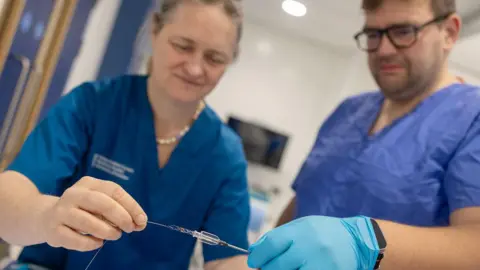
Surgeons from the Scottish region and America have successfully completed what is thought of as a historic stroke surgery employing a robot.
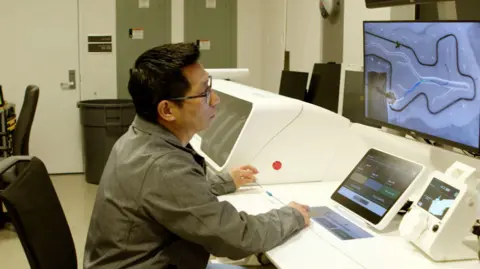
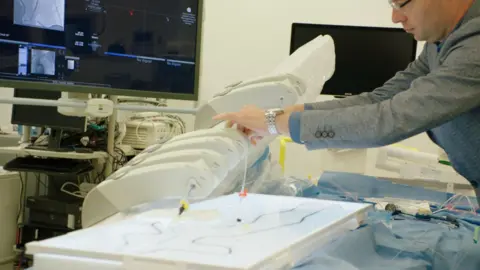
Prof Iris Grunwald, associated with a research center, executed the long-distance surgery - the elimination of vascular blockages post a cerebral event - on a donated body that had been provided for research.
The expert was located at a treatment center in the location, while the subject undergoing procedure via the system was across the city at the university.
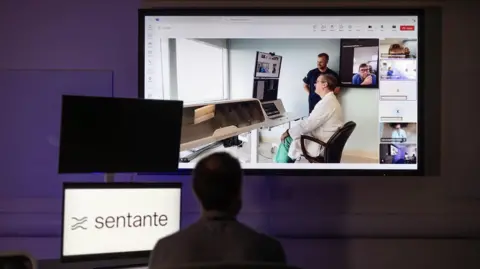
Subsequently, a medical specialist from the American state used the system to carry out the first transatlantic surgery from his Florida location on a medical specimen in Scotland over 6,400km away.
The team has described it as a potential "transformative advancement" if it becomes approved for medical treatment.
The medics consider this innovation could change stroke treatment, as a slow access to expert care can have a major influence on the chances of recovery.
"The experience was we were observing the first glimpse of the future," said the medical expert.
"Where previously this was regarded as theoretical concept, we demonstrated that every step of the operation can already be done."
The medical research center is the international education hub of the global medical association, and is the sole location in the Britain where doctors can work with donated bodies with biological fluid circulated in the blood pathways to simulate procedures on a actual patient.
"This was the first time that we could conduct the whole mechanical thrombectomy procedure in a real human body to demonstrate that each stage of the procedure are feasible," explained the primary researcher.
A charity executive, the head of a medical organization, labeled the intercontinental surgery as "a significant breakthrough".
"For too long, residents of remote and rural areas have been limited in obtaining to clot removal," she added.
"Such technological systems could address the disparity which occurs in medical intervention throughout Britain."
What is the operational process?
An brain attack takes place when an artery is blocked by a clot.
This cuts off circulation and oxygenation to the neural matter, and neurons cease working and expire.
The superior intervention is a clot removal, where a specialist uses catheters and wires to remove the clot.
But what occurs when a patient is unable to reach a specialist who can perform the surgery?
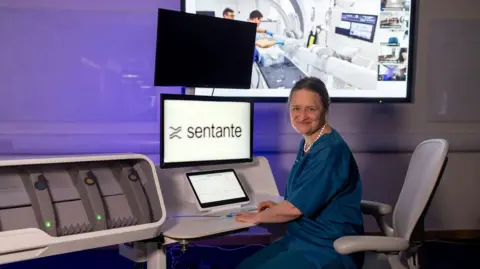
The lead researcher explained the experiment showed a robot could be connected to the same catheters and wires a surgeon would normally use, and a medic who is present with the individual could easily connect the wires.
The expert, in a separate site, could then operate and direct their own wires, and the robot then executes exactly the same movements in real time on the patient to conduct the thrombectomy.
The individual would be in a medical facility, while the specialist could perform the surgery with the technological system from any place - even their own home.
The medical expert and Ricardo Hanel could view live X-rays of the body in the experiments, and track developments in live conditions, with the lead researcher stating it took just a brief period of instruction.
Major corporations leading tech firms were contributed to the research to secure the communication link of the mechanical device.
"To perform surgery from the United States to Scotland with a 120 millisecond lag - a blink of an eye - is genuinely extraordinary," said the neurosurgeon.
Advancements in brain care
The lead researcher, who has won an award for her research and is also the vice president of the World Federation for Interventional Stroke Treatment, stated there were two main problems with a standard thrombectomy - a worldwide deficiency of doctors who can perform it, and intervention relies upon your physical place.
In Scotland, there are just three locations individuals can obtain the treatment - three major cities. If you don't live there, you must travel.
"The procedure is highly dependent on timing," stated the lead researcher.
"For every six minutes of waiting, you have a slightly decreased likelihood of having a positive result.
"This system would now deliver a novel approach where you're not depending on where you reside - preserving the valuable minutes where your neural tissue is degenerating."
Public health data showed there were {9,625 ischaemic strokes|numerous cerebral events|


